Shopping Cart
All orders qualify for 30 day trial & complimentary US shipping!
-- No items so far --
Total:
0
Support
Need help? Our Pool Experts are here to help.
All orders qualify for 30 day trial & complimentary US shipping!
-- No items so far --
Total:
0
Need help? Our Pool Experts are here to help.
You're probably familiar with a hydrogen peroxide as a topical antiseptic for disinfecting a cut or maybe for bleaching hair. What you may not know is that hydrogen peroxide is a powerful oxidizer that can be combined with ultraviolet light to disinfect swimming pools.
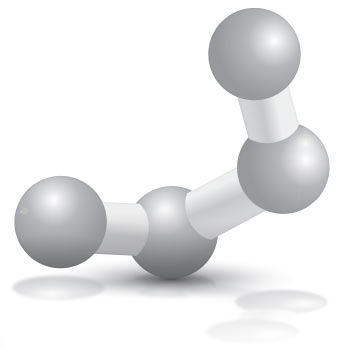
The combination of ultraviolet disinfection with hydrogen peroxide allows pool owners to safely eliminate all chlorine in their pool or spa. Unlike some other methods for creating a chlorine-free environment, the combination of ultraviolet disinfection and hydrogen peroxide is both proven and effective. This method is most popular in hydrotherapy pools and spas, and with individuals who are allergic to common pool chemicals.
A 35% concentration of food grade hydrogen peroxide is most commonly used in swimming pools and spas. Some users prefer a 50% concentration. This concentration is much higher than the 3% concentration used for medical purposes.
Hydrogen peroxide is a strong oxidizer. When it comes to oxidizing, it’s actually 30% more powerful than chlorine. But when it comes to disinfecting, hydrogen peroxide is less powerful than chlorine. Hydrogen peroxide requires ultraviolet light disinfection as the primary disinfection agent. Although hydrogen peroxide cannot be used alone, the combination of ultraviolet disinfection and hydrogen peroxide can be very effective.
- The Environmental Protection Agency
Hydrogen peroxide disinfection requires a high dosage. Although it varies depending on bather load, the typical concentration of hydrogen peroxide is 30 to 40 ppm in a typical swimming pool or spa. Some high-use pools and spas may require up to 100 ppm.
Hydrogen peroxide reacts very fast and disintegrates into hydrogen and water, increasing the amount of oxygen in the water. Since hydrogen peroxide disintegrates rapidly when placed in a swimming pools or spas, daily monitoring and constant dosing is recommended. The decomposition of hydrogen peroxide can be delayed by adding a stabilizer to the water. Water can also be shocked with hydrogen peroxide to improve water quality.
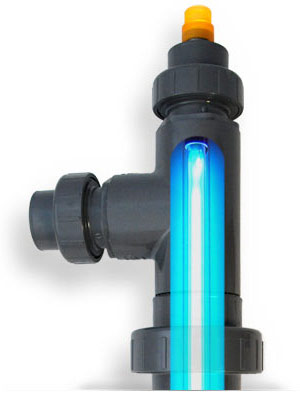
The combination of hydrogen peroxide and ultraviolet light produces reactive oxygen radicals that both oxidize and disinfect. These radicals are powerful oxidizers that have an enhanced ability to destroy pathogens. Ultraviolet disinfection alone destroys more than 99.5% of pathogens that pass through the chamber. Additionally, powerful reactive oxygen radicals enter the pool and control pathogens that do not pass through the UV chamber. For example, reactive oxygen radicals render pathogens that attach to the pool wall harmless.
Ultraviolet and hydrogen peroxide is so effective at controlling biological growth, that is has become the method of choice in high volume medical facility pools. Warm water therapy pools and therapy spas are breeding grounds for bacteria and other pathogens. Ultraviolet combined with hydrogen peroxide is extremely effective at controlling bacterial growth, destroying organic matter, and improving water clarity.
Perhaps the biggest disadvantage is the relatively high dosage required and the short life of hydrogen peroxide. Also, hydrogen peroxide is not compatible with DE filters, which represent about one/fourth of the residential swimming pool market. The hydrogen peroxide will actually dissolve the DE. Additionally, the hydrogen peroxide levels must be carefully monitored and adjusted. Installing an automatic dosing system with an oxidation reduction potential (ORP) controller will add significant expense. We cannot forget that hydrogen peroxide levels greater than 100 ppm are dangerous and can be harmful to the eyes. As with any strong oxidizer, care must be taken when storing and handling.
We often get the question, “Should I use chlorine or hydrogen peroxide with SpectraLight UV systems?” It depends. First, it is much easier to use hydrogen peroxide in a small body of water, such as a swim spa, hydrotherapy spa, or small indoor pool, than a large body of water. Due to the dosage required, larger bodies of water can be more challenging. SpectraLight can be used with just 0.5 ppm chlorine. But 30 – 40 ppm hydrogen peroxide is required. That’s a big difference, especially when you consider how much hydrogen peroxide must be added each week.
Second, we always ask if there is a reason for not using chlorine. If someone is allergic or sensitive to chlorine, then hydrogen peroxide should be used. However, many pool owners base their decision to get away from all chlorine on a bad experience with water chemistry or misinformation. A low dosage of chlorine is safe and effective. All of the common problems with chorine are a result of poor water management, chloramines, and other chlorine by-products, not the chlorine itself.
SpectraLight clients are delighted when they discover how easy pool maintenance can be when SpectraLight is combined with a low dosage of chlorine (just 0.5 ppm). Most importantly, SpectraLight eliminates chloramines and disinfection by-products, making pools safer, healthier, and easier to manage than traditional disinfection methods.
There are a number of alternatives for swimming pool sanitation. Compare UV to chlorine, ozone, ionization and other technologies here.